Once we had had our conversation about what our film introduction would entail, drawing inspiration from the audience research, film opening analysis and director anaylysis it was time to combine our ideas into one product, a psychological thriller. Everybody in the group worked on the storyboards which consist of 18 shots.
Below is the filming schedule created...
Our Cast
Antagonist
Ben Nixon
Over a period of two weeks me and the rest of my group were trying to find cast members to play the three roles needed. To increase efficiency we thought it had to be someone we knew outside of school or someone from inside of school. We posted messaged on Facebook advertising an acting role and only gained a few responses. After looking at the names available they didn't really fit the role well enough as we needed someone who looked older than a young adult to play the role of the antagonist, otherwise it wouldn't seem realistic. I suggested my friend Ben Nixon who was slightly smaller than me and had a beard. The fact that he is seen as an attractive man was a bonus for us because it meant that the audience would then be torn between warming to him and being frightened of him.
Victim
Izzi Harrison
To play the role of the victim we needed someone who had similar characteristics of a classic victim in thriller, such as Victoria (played by Laia Costa). Someone who has a petit frame and a pretty face was our preference because it would be easy to show how stereotypically vulnerable they and the audience would feel inclined to feel sorry for them. To increase efficiency when it came to acting we needed some again in school. Ben at this point had already agreed to be the antagonist and so the group put forward Izzi Harrison to act as the victim as it was not a hard role, that required no movement, but would extremely beneficial in terms of time.
Detective
Candice Feddis
To increase our USP (Unique Selling Point) we didn't just want to following the mainstream conventions and stereotypes surrounding women in thrillers. In an attempt to break the mould we scrapped the idea of a male playing the role of detective. Our group is made up of 3 girls and 1 boy and due to the fact that that male acted in the preliminary task we decided to have a female detective. We quickly studied some films in which this had been applied and the gender roles had been subverted. Most notably this could be seen in Suicide Squad, 2015, in which the head of a government crime branch was a black female, Viola Davis, in a white-male dominated genre. Again to increase efficiency and the fact that she had experience working in front of and behind the camera, Candice Feddis was put forward to be the detective.
Drawing inspiration from fellow directors, films and in an attempt to include a wide array of media platforms and forms of presenting our work, rather than write out our initial ideas we had a consultation including imput from a media teacher. This improved efficiency and allowed us to capture flowing ideas which may otherwise be missed. In order to come up with our own film idea we talked of our favourite film genres and narrowed down that list taking into the resources available to us and how we could portray representation through this. Due to a lack of resources provided to us we decided we would either go down the route of a Thrillers or Dramas as it appears rather evident from watching films such as 'Shutter Island' and 'Inception' that despite using high quality cameras the light and sound, aspects of mise en scene, had the most impact on the film. We discussed our love for films with psychological twists and films that "made you think" (a deeper meaning or motif to the story). Through the use of the colour red and white we decided to have a plot twist in our film introduction. Red is the color of fire and blood, so it is associated with energy, war, danger, strength, power, determination as well as passion, desire, and love. Red is also very emotionally intense color. It enhances human metabolism, increases respiration rate, and raises blood pressure. It has very high visibility, which is why stop signs, stoplights, and fire equipment are usually painted red and so can be used as a warning to the viewer. We would aim to lure one into assuming that the rest of the film would be based around a romance (with a male and female character) but then turns out that someone has been abused, harmed and eventually killed, as provided with insinuations throughout the film introduction.
The full conversation can be listened to below
To add to the sinsiter, realistic feel to the film introduction we wanted to make the audience feel uncomfortable. Taking inspiration from 'The Fall' in which a supposed normal family man is also murdering women in the night and then goes home to care for his children. We would aim to play on this by setting the murder sequence in a normal house. Through using school bags one would then assume that the victim also has children and if the audience were to see that the murder happened in such a common place then it would hopefully make them feel uncomfortable, subsequently adding to the suspense. Having the murder scene affected by the high keynatural white light shining on the bed will provide a sense of purity and innocence of the victim and then will be shrouded by low key lighting and colours outside of the murder zone (preferably black and grey).
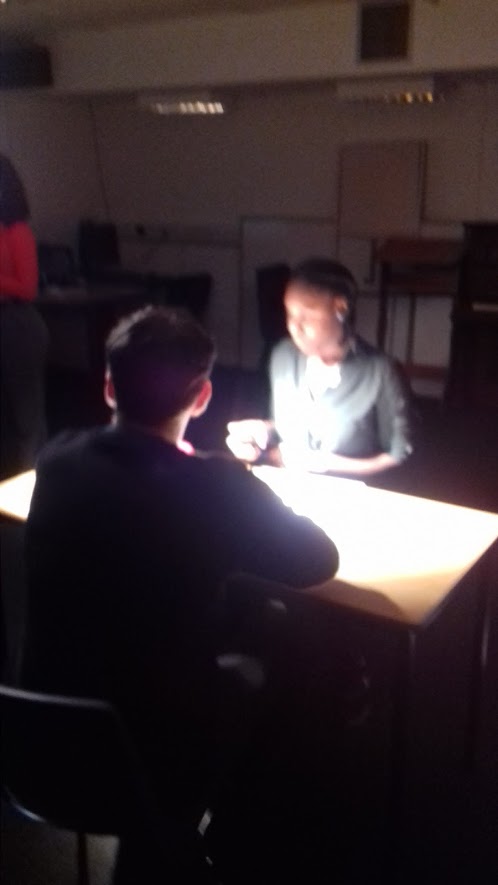
In the final part of the film introduction we wanted the audience to realise that the antagonist had mental health issues and was physcologically disturbed. We aimed for the audience to get an insight into the character. The plan is too shine a bright yellow stage light on the antagonist as yellow stands for freshness, happiness, positivity, clarity, energy, optimism, enlightenment, remembrance, intellect, honor, loyalty, and joy, but on the other hand it represents cowardice and deceit. The spotlight is focused on the detective and the antagonist and we aim for the audience to build up their opinion of the character. The room will be lit with low key lighting and so despite his face being hit by yellow light the surrounding light will be full of low key lighting. Black is associated with power, elegance, formality, death, evil, and mystery. Black is a mysterious color associated with fear and the unknown (black holes). It usually has a negative connotation (blacklist, black humor, 'black death'). By doing this the audience focuses not only on the mystery of the antagonist but also the power of the detective and what secrets they may hold.
The idea is to make a psychopathic thriller in which the antagonist has abused a woman. It will be set in a private building where the audience assume that the woman who is either asleep on the bed or the male antagonist is sharing an intimate moment with her. From our audience research Stephen Spielberg, Quentin Tarantino and Alfred Hitchcock seems extremely popular in the film world and so I will be analysing a film of theirs.
Jaws Stephen Spielberg, 1975 It's a hot summer on Amity Island, a small community whose main business is its beaches. When new Sheriff Martin Brody discovers the remains of a shark attack victim, his first inclination is to close the beaches to swimmers. This doesn't sit well with Mayor Larry Vaughn and several of the local businessmen. Brody backs down to his regret as that weekend a young boy is killed by the predator. The dead boy's mother puts out a bounty on the shark and Amity is soon swamped with amateur hunters and fisherman hoping to cash in on the reward. A local fisherman with much experience hunting sharks, Quint, offers to hunt down the creature for a hefty fee. Soon Quint, Brody and Matt Hooper from the Oceanographic Institute are at sea hunting the Great White shark. As Brody succinctly surmises after their first encounter with the creature, they're going to need a bigger boat.Written by garykmcd (Accessed on IMDb) Representation and Mise en Scene As the camera pans over the group of teenagers, you can see fire which the students are sitting around. The fire is added into the scene as it is an element and connotes safety and warmth, this is effective as the audience can guess and focus on the character that is in the most danger and unsurprisingly the character that was sitting the furthest away from this symbolism of comfort is ironically the first to get injured. Sound In the opening of Jaws, the music used is very significant and is successful in creating the suspense filled atmosphere of a typical thriller genre. The director chose to allow the audience to hear the non-diegetic music before the image emerges from the black screen, this creates a huge amount of tension as the audience senses are restricted, they cannot see what is happening but the dramatic and mysterious music indicates that the following events will not be good. The tempo of the music fits well with the camera movements, as when the camera (tracking the shark) speeds up as if the shark is hunting its targeted pray, the music speeds up and increases in volume. Then, just as you assume something is about to happen the music changes as camera suddenly cuts to a completely contrasting shot where you hear diegetic sounds of people communicating, kissing, laughing and making music normal teenage things, completely oblivious to the dangers in the water that we as the audience know about. The characters are making their own music using raw instruments like guitars and harmonicas; this is done to create and emphasise the contrasting shot of these people relaxing and having fun. Opening Titles The opening of Jaws doesn’t hold much back and tells the audience the production company, distribution company and the people that made the film possible with the title of the film all before the action unfolds. This is a successful start as it gives all the information away when the audience are waiting for the film so they will not just over look it and the title helps the audience to discover the point of view shot is from the point of view of the shark. Furthermore, they are shown over the iconic soundtrack to ensure they don't lose focus, the beginning of the soundtrack begins quiet and the text at the start suits and fits in well helping to create the build up. In addition the font used is very basicand bold and the colours are basic black and white keeping to the thriller convention of dull dark colours creating a mysterious atmosphere as if to prepare the audience.
Kill Bill Vol.1 Quentin Tarantino, 2003 The lead character, called 'The Bride,' was a member of the Deadly Viper Assassination Squad, led by her lover 'Bill.' Upon realising she was pregnant with Bill's child, 'The Bride' decided to escape her life as a killer. She fled to Texas, met a young man, who, on the day of their wedding rehearsal was gunned down by an angry and jealous Bill (with the assistance of the Deadly Viper Assassination Squad). Four years later, 'The Bride' wakes from a coma, and discovers her baby is gone. She, then, decides to seek revenge upon the five people who destroyed her life and killed her baby. The saga of Kill Bill Volume I begins. Written by JD (accessed on IMDb) Camera, Mise en Scene and Representation Black and white is used in the opening scene to represent a flashback, this helps to create a complex narrative that is common within some thrillers, namely films like ‘Fight Club’ and‘Memento’. This immediately establishes the genre because Tarantino is using a generic thriller convention that pays tribute to early noir thrillers such as ‘The Third Man’. Tarantino uses Chiaroscuro lighting to create a strongly contrasting shadow across The Brides face, this helps to connote mystery and engages the audience as they are yet to see the character fully. This effect was most likely created by using non-ambient lighting, this is deductible by the full range of tonal values within the mise en scene and this could easily created by using bright non-ambient lighting. Tarantino is again establishing the genre early on by using this technique as it can be seen in classic noir thrillers to create suspension and mood, as can be seen in the picture to the left. A close up shot is used to show only the feet/boots of Bill.The close up shot is used to engage the audience and place them within the mise en scene as though they are with the characters, but this time it could be perceived that Tarantino has used the close up shot to purposely conceal the identity of Bill. A similar shot is used in the film ‘Witness’ (toilet murder scene) to build tension amongst
the audience, therefore Tarantino is establishing the genre by making reference to this. Tarantino uses the close up shots throughout this whole scene, this ensures the pace is kept and the audience are put within the heart of the action. Close up shots also help to place the audience in the mise en scene and in doing so, engages them with the film. In this particular shot the close up is used to show the emotions of The Bride, this creates a connection between the character and the audience, allowing them to feel sympathetic towards The Bride and immediately marking her out as the ‘hero’ or ‘good guy’. The shot could also be considered a POV as it seems the audience are put in the shoes of Bill when looking at The Bride, this positions the audience in the mise en scene and further captivates them
Sound and Representation
The diegetic sound of the footsteps are very important in this shot. The sound of foot steps help to connote fear or menace which helps to create suspense within the audience, especially as only the heeled boots can be seen and thus engaging the audience. Another important diegetic sound is the shallow, panicked breathing coming from The Bride. This can be heard over the opening titles and throughout most of the opening scene and it helps to create tension as it shows the vulnerability of The Bride in comparison to Bill. Also as Bill walks the floor creeks (diegetic), this makes Bill seem sinister, especially as the sound is real. Bill is seen to be wearing cowboy boots, this could possibly tell the audience that he is a ‘redneck’ or comes from a southern state.This gives the audience a little hint about Bill’s character, this leaves the audience speculating and helps to captivate the audience. This is an effective device, known as an enigma, which means a person or object that is mysterious, puzzling or difficult to understand. In this case the enigma is the character of Bill as the audience to getto make the connection with the face of Bill. The shadow created by Bill’s boot creates a sense of moral ambiguity and a general feeling of fear. This helps to add to the idea of the enigma as it makes Bill appear to be more mysterious, which of course, draws in the audience. The dark tones of what Bill is seen to be wearing could suggest his morality within the film, much of his clothes are darker colours (this also fits with the films soundtrack Bang Bang by Nancy Sinatra, especially the lyrics “he wore black and I wore white”) and this could lead to suggest that Bill may be what some may consider a sadist. These small hints can help to intrigue the audience as they are left guessing about Bill. The sound of a gun being loaded can be heard quietly in the background, this subtly prepares the audience for what is about to happen. Although the prior warning, the sound (non-diegetic)of the gun fire is used to make the audience jump, this intrigues the audience as it comes as a shock. Guns are generic conventions as they are used to symbolise death, as can be seen in ‘The Killing’ or ‘Natural Born Killers’ and so Tarantino is using this to establish the genre of the film.
Psycho Alfred Hitchcock, 1960 Phoenix office worker Marion Crane is fed up with the way life has treated her. She has to meet her lover Sam in lunch breaks and they cannot get married because Sam has to give most of his money away in alimony. One Friday Marion is trusted to bank $40,000 by her employer. Seeing the opportunity to take the money and start a new life, Marion leaves town and heads towards Sam's California store. Tired after the long drive and caught in a storm, she gets off the main highway and pulls into The Bates Motel. The motel is managed by a quiet young man called Norman who seems to be dominated by his mother.Written by Col Needham (accessed on IMDb) Representation and Mise en Scene Marion in the characters opening shot looks passive, she’s the one lying down on the bed and that is her fate as that is the way she shall die – lying face down on a bathroom floor barely dressed. At first when we see her she is dressed in white which has connotations of innocence. In a later scene this changes and we see that she is wearing black underwear when she gets dressed to leave with the money that she stole. Immediately the earlier white’s connotations of her innocence are sullied as has our perception of her character. Once again whilst Norman Bates is watching her change through the peephole, she is wearing black underwear – she is a doomed woman. In addition, his watching through the peephole reflects the beginning of the movie where the audience watched Marion secretly through a window in her underwear, hinting that Norman is the killer. Camera The beginning is one long panning of the establishing shot with no cuts – then a very sudden cut, jerking. It lulls the reader into a false sense of security expecting further panning then ripping them away to a new sight, interrupting the fluidity and reflecting the state of Norman Bates mind. There is a close up high angle shot of the open window, zooming in – we are not going in through the door but unseen through the window, for a glimpse of someone’s private life. It gives a very voyeuristic feel to the viewing. The camera feels as if it is scanning across the city and the window it chooses quite random – choosing a victim, watching their behaviour through a window. It makes the audience feel uncomfortable as it is as if placing them within Bates’ mind, and the camera is shaking very slightly as it zooms in on that window, not entirely stable as neither is Norman. There is a medium opening shot of the characters, mid-level. The blonde woman Marion Crane is the primary person seen, and this tells us that she is our main character as all you can see of her lover Sam is his torso. Sound The non diegetic parallel music which plays in the beginning is very dramatic, the string instruments being played at a very fast pace. It is dark, discordant and full of suspense, giving the feeling that time is running out and you are being chased. Even the music seems to have no idea of where it’s going, sharply plucked high pitch strings one moment and then very low pitch the next, it is wild and unpredictable. Titles Establishing the setting is the place (Phoenix, Arizona). Then there is the date which has no year with the effect that the film feels still very relevant, as if the events within it could happen at any time and place, today, now, this year. The time is written in words, and makes it seem like a police file within the aftermath of a crime and contradictory to the effect of the date missing the year, marking when everything happened precisely – again an indicator of the split personality of the film. When the opening credits roll the screen and text are at random being split into bars, into two and then are moving around constantly. Even the bars are unstable, sometimes splitting sideways and other time vertically these too are changing all the time – everything is unstable. This reflects the dual nature of Norman Bates, hinting at the later revelation of his split personality.
After analysing some general drama and thriller film openings it was then key to refine our ideas so we were focusing on one aspect of the film world and from then on we could plan for our own film. We took inspiration from the film opening analysis, our favourite directors (Hitchcock and Tarantino) and the camera work we have knowledge on and advanced upon from our preliminary task to come up with a genre to focus on, a thriller. Camera and Sound have a huge impact on representation and creation of ambiance and with a thriller it seems like there are many techniques one could use to create that, from lighting, setting, opening titles. We felt thrillers had the most depth to it compared to any genre and we had some experience in creating drama. After establishing the genre we wanted to use in our own film opening was a Thriller we then had to refine our ideas. This was carried out in two ways....
Background research into Thrillers
Producing a questionnaire
Background Research Into Thrillers
Definiton
Thriller is a broad genre of literature, film, and television programming that uses suspense, tension and excitement as the main elements. Thrillers heavily stimulate the viewer's moods giving them a high level of anticipation, surprise and anxiety.
History
Over the past 30 years the thriller genre has changed a lot, this may be because of the advanced technology, special effects and our evolving culture. The thriller films that were produced during the 1940's - 1970's were based on peoples actual fears. These films were considered realistic. The modern thrillers have many sub-genre's such as disaster, mystery and crime.
Sub-genre and Hybrids
The thriller genre can include sub-genres and hybrids which may include elements of other genres; for example, crime thriller, mystery thriller and action thriller.
(Sub-genre = a type of genre within another genre. Hybrid = two types of genres in one)
Examples of Sub-Genre Thrillers:
Red Riding Hood (1697), an early example of a psycho-stalker fairy tale story
Frenzy (1972), a violent thriller
Dead Calm (1989), a psychological thriller
Taken (2000s), a spy/action thriller
What does it need to achieve?
A thriller film needs to hook the audience and keep them on edge, building tension and suspense. To heighten the interest of the audience it will hide information and/or identities, such as providing misleading information to make the audience off track and confused.
Characteristics
The suspense is a crucial characteristic of the thriller genre. The suspense in a story just keeps the person hooked into reading or watching more until the climax is reached.
Some classic themes/characters;
Ransom
Kidnapping
Mind-games
Death-traps
Paranoia
Protagonist, Antagonists, Authority (eg. Police), figure of innocence
Death, conflict
Quests, mysteries
Questionnaire
Now that we had some background knowledge on a Thriller we had to refine the genre so we could come up with some of our own ideas. I made a questionnaire on the free website SurveyMonkey (https://www.surveymonkey.com/) to gather responses. I asked ten questions, five of which were general thriller questions and the other five would be applicable to our plans.
We received 18 responses for this question. 16.5% of the responses said 'Shutter Island' and another 16.5% for 'Inception'. In terms of directors Hitchcock's films received 11% of the vote, with Rebbecca and Physco. More importantly 71.5% of the films voted involved a plot where women are either killed, abused or threatened.
From this we can see that the timing is not very relevant to the story according to the audience research. Just under 30 % of the ovtes wouldn't mind if it was present time, flash forward or everyday life. This allows us to have some freedom on what we choose to do.
Analysis
After receiving feedback from our online questionnaire it was time to incorporate that into one idea. Q1 shows that 71.5% of the film chosen involve a woman being abused or abusive in some way and it would be clever to incorporate that into our own film opening. Q2 shows the majority wanted a physcological or mystery thriller and it should be very dark with a lot black or low key lighting (Q3). Parralel to our research music, with 60% of the votes, and camera work, with 16%, have the most effect on a thriller and rather than focus on the dialogue, if there is any at all, it is more relevant to enhance the visuals. Q7 and Q9 highlight how a successful thriller doesn't give of much information and it should slowly be fed to the audience as the film progresses, therefore holding a sense of supense, 36% of the voters said this is the most appealing factor to a thriller, and secrecy. Finally Stephen Speilberg was voted as the best thriller director with a landslide 60.87% of the votes and we will look to incorporate some of his ideas.
This audience research works really well for our group. I work in a group where I am the only boy and am working with 3 other girls. One of which has recently moved into a new house with a basement. As seen with Q3 and Q4 and in unison with 'Sixth Sense' basements are perfect for creating atmosphere and we incorporating that into our film intro could make it very successful. In addition with 71.5% of the films being voted in involving women being abused or abusive then it would also make sense to set the thriller opening around a woman being abused in a private building with elements of suprise and suspense. The abuser would be a male, conforming to the sterotype that males are dominant and stronger and women are vulnerable, who would have some sort of physcological issue causing him to act in a certain ways.
Before analysing film openings, my group and I aimed to narrow down the genre's we could use for our main task. Taking inspiration from our favourite directors (including the likes of Alfred Hitchcock, Quentin Tarantino) and our continuity editing task we concluded that we wanted to head down the route of Thrillers (possibly Crime-Thriller) enabling us to gather classic conventions used in thriller openings (as seen below) and try and implement those into our own work or even diverge from those/breaking those stereotypes. Camerawork and mise on scene are key components to this task and so we also gathered ideas from some dramas as well to gain some expertise in the build up to the filming.
The Usual Suspects (Thriller)
Bryan Singer, 1995
Usual Suspects DVD Cover again continues this recurring theme of shadows (often used in thriller
Representation Shadows (as the face of the supposed protagonist (victim) has shadows over half his face) have connotations of a sinister past and mystery.Only showing the body of the ‘antagonist’ hides the identity of the character whilst keeping a sense of secrecy and intrigue to the introduction as the audience want to know what relevance he has to the dead bodies (enigma). Making links to a deeper meaning and the classic conventions of thrillers. They are often dominated by males and when a woman/women do feature they are often in vulnerable positions.
Mise en scene The black coat worn by the antagonist has connotations possibly to their character which is dark and sinister and possibly trying to hide something. In terms of the setting we can see low key lighting has used and with that matched with the opening sequence being set on a boat of some sort creates a menacing atmosphere. Stereotypically docks are used in films, especially crimes and thrillers, to create an ambiance. They are often used to isolate people, hide or smuggle things. Use of Camera Initially we see an extreme close up on a box of matches. At first glance it may seem like this is just a seemingly everyday object filling up the screen but it is later symbolic through the fire created on the ship that small objects can have a big effect and highlights how every object matters in a scene. We also see the use of slow motion (camera editing) of the flames engulfing everything in it's path and this is used to emphasise the drama Sound As used in our preliminary exercise and a common occurrence in many thrillers we don't see the murder itself in this film as we are only informed of the murder through the use of asynchronous/off-screen sound. Suspense grew throughout the scene as well through the sharp non-diegetic sound of a single violin, creating an eerie atmosphere, which parallel to the action got louder as the film proceeded. Foreshadowing of ones death is used as well through the dripping of oil which was the fuel for the fire. This ghostly sounds like a ticking clock and a warning that someones life is about to come to an end. The idea of superiority and inferiority is also present in the opening sequence. The antagonist refers to the victim as 'kid' not only showing some history between the two but also how the protagonist is extremely vulnerable. Narration & Form The opening sequence of 'The Usual Suspects' is extremely restricted. We are only introduced to two characters, the victim and the murderer, and even then the audience knows less than the characters. We are unaware of the history these two characters have and what the antagonist even looks like. All of the story is confined to one area, the boat. Therefore the audience are forced to focus heavily on the characters and the fire. Both of which follow one line of action Sub Genres and Target Audience The opening sequence to this thriller is one that could be easily mistaken for a crime drama due to the use of sirens at the end of the opening and the clothes worn by the antagonist the long coat especially, often symbolise hidden secrets and a sinister past and the norm is for this to be uncovered in a crime thriller. In addition due to the heavy explosions and industrial remote area this itself could also be mistaken for an action film. I think this film is targeted at young adults. This thriller requires the audience to think on their feet as the plot isn't immediately handed to you on a plate. A younger audience may struggle to understand or unpick the maturity of the conventions and due to the strong language later used in the film and relevance to drugs it therefore would suit a mature audience, 18+.
Pulp Fiction (Crime/Drama) Quentin Tarantino, 1994 Representation & Mise en Scene The opening sequence to 'Pulp Fiction' doesn't really give much away. The behaviour of the male and the female within the couple are different. The man comes across agitated and excited as he’s leaning back and forward in his chair and constantly fidgeting. He shows rebel like attitude yet relaxed behaviour, the use of the cigarette in his hand backs up this point as it has a stigma of people occupied by other things and acting against the norm, It can also be good for allowing characters to take a pause, causing effect and suspense. In comparison to the woman who is sitting up straight, sounding innocently happy and politely accepts coffee. They are both wearing normal, relaxed clothing, with messed up hair and tired looking faces. It is only as the scene develops that you realise that they are experienced criminals, leading the audience to anticipate what is about to happen next.In this scene the man is seen as the dominant figure and leader of the act as he instigates the robbery and it implies that the woman is ducking away once he climbs on the table, implying that she’s taking cover, the scene then peaks as the ideas are put into action. Her innocent reaction to killing someone shows that they are not conventional gangsters as it doesn’t live up to the expectations of an ordinary crime thriller, giving the impression that they’re only doing it for the money. Once the plan has concluded, the woman goes from being calm and innocent to excited to commit a crime, the seriousness of the anticipated crime is shown once the gun is placed on the table. The kiss and loving words that the couple exchange before they rob the diner is almost a good luck kiss for what is about to happen, the calm before the storm. Sound Again Quentin Tarantino has used the element of surprise to enhance the drama unfolding. In the background of the diner we can hear asynchronous contrapuntal diegetic calm music matched with chatter one would assume that the scene unfolding is a calm one. However this is then subverted as the music screeches to a halt and Mia Wallace starts screaming and pulls out a gun. Camera and Form The opening sequence is unrestricted. The two characters talk of their past and what their plans are for the future and it becomes very clear that they are criminals and only follows those 2 lines of actions. The same can be said for the Camera work used. Throughout the whole opening sequence the camera only focuses on the two characters. Through the use of 2 shots and shot-reverse-shots we are forced to focus on what the characters are saying. Even when the waitress arrives she is either seen with an extreme close up almost from a point of view shot to show she has some relevance to Mia and Pumpkin's thoughts and then she is blocked of completely where we only see the back of her. This highlights the intensity of the conversation and again really forces the audience to listen in on what the couple are saying and doing. Titles This intensity is again reiterated in the opening titles. The font colour is a simple yellow wiping up the screen and the name 'Pulp Fiction' appears very quickly. This allows the action to unfold very quickly and we are drawn immediately to what is taking place in the diner. Target Audience and Sub-Genres One would initially think this film is a romantic one due to the deep red seats provoking connotations of love and the strong chemistry between the two characters on screen. Therefore meaning this film would in most cases be appropriate to a younger audience. However as soon as the plot switches and we see Mia use some swearwords, within the opening 3 minutes, and she pulls out a gun we can see that this is not a romantic story but a violent and crime driven story which has relevance to drugs and murder, the norm in Tarantino films. Therefore it would be inappropriate for younger viewers and deserves its 18 rating.
Sixth Sense (Thriller/Drama) M. Night Shyamalan, 1999 Representation We can see a different in class in the opening sequence. Child psychologist Dr. Malcolm Crowe (Bruce Willis) is dressed formally after receiving an award for his work. His wife is dressed similarly. However when the story goes upstairs we can see a young man without any clothes on. This symbolises raw emotion and how disabled people are vulnerable and under appreciated compared to those more able bodied. Mise en Scene Throughout the opening sequence Shyamalan toys with our emotions. The married couple are lured into a false sense of security. The scene starts off when Olivia Williams' character is collecting wine from the basement. The basement provokes connotations of a horror film or a dark and clutter thriller. However as she goes upstairs we see a lavish living room with extravagant paintings and furnishings surround the couple. So as the audience gather that this film is going to be quite dark the couple are lured into a false sense of security. Camera Just as it was in 'The Usual Suspects' we don't see the death of Vincent. Whether to hide some sort of secret or some other reason a slow pan partnered with slow motion is used during the shooting scene, emphasising the drama that has unfolded. In addition Bruce Willis' character who appears to be powerful through his formal dressing is pushed into an inferior position by Vincent as a high angle shot is used. Sound Often in thrillers no sound at all can create an extremely uncomfortable atmosphere and this has been applied in this opening sequence. The audience is forced to listen intently to the conversation Olivia Williams and Bruce Williams are having due to the silence around them. In parts when there is no talking suspense grows as you expect something to happen suddenly. This sense of warning and on edgeness is later reiterated as the couple go upstairs Olivia Williams sees that the phone is off the hook. Not only can we see that someone has broken into the house due to shadow that sweeps across the room but prior to that the audience gather that the suspense is about to come to it's climax. This because the phone (a seemingly everyday object) is creating a beeping noise, like an alarm, foreshadowing danger. Narration and Form The plot itself is relatively unrestricted. We gather that there is a married couple in which the male is a renowned doctor of some sort. Despite us not knowing what is really going on we can assume that he has done some work in the past that hasn't been successful as Vincent (the man with the gun) refers to him being a patient to Bruce Willis. However it is hard to really grasp the story as the atmosphere switches from basement to a relaxed setting and then to a crime scene. Titles, Sub-genres and Target Audience The title sequence invokes connotations of ghosts or fog as it has a pure black background with fading white text appearing then disappearing. Partnered with the break in and the constant use of low key lighting one would assume that this is a horror film or a psycocological drama due to persona of Vincent. Being based around psycology this a subject that young audiences often find it hard to grasp yet due to the lack of genuine gore this would be suitable for viewers aged 15+.
Se7en (Thriller) David Fincher, 1995 Representation and Mise en Scene From the off a sinister mood is created. The apparent antagonist covers words such as heterosexual, transsexual, pregnant symbolising or foreshadowing someone losing their identity or that the antagonist has an extremely secretive past. The pictures in the opening sequence could be similar to that of a police investigation linking the sequence to a crime of some sort. Furthermore the antagonist has dirty hands and bandages clearly visible creating an uncomfortable atmosphere for the viewer. Sound and Camera Non-diegetic dramatic repetitive music matched with parallel noises of a chainsaw and children crying creates an extremely sinister mood. This is reiterated through the camera as we see a lot of high angle extreme close up. This gives of the impression that we are looking into the life of an antagonist who is very dominant and the victims vulnerable. A tilt is constantly used as to distort the viewing and make the audience apprehensive. Narration & Form The storyline is extremely restricted. We don't know who the antagonist is or what relevance the pictures have and we can only see the hands of one person and their tools. It's very secretive without any structure at all. Sub-Genres and Target Audience Without knowing the story one could easily assume that this is a horror, more specifically a body horror, due to the pick in the back of one head and the apparent victimisation of what could be a serial killer. Being such a dark film it would be inappropriate for a younger audience and would appeal to those who are used to scary films. A mature audience would be able to see beneath the threat and understand the story to a greater extent. Titles The opening titles look very similar to that of a child's scribble. The white font on a black background, simplicity, allows the audience to focus on the distorted fading writing, parallel to the story possibly (distorted).
Similar to the Usual Suspects an extreme close up has been used and we can see low key lighting to create a shadow effect on the face of Leanardo Di Caprio (Teddy Daniels). We also see an establishing shot in the background partnered with low key lighting and dark tones to create a sinister feel from the off.
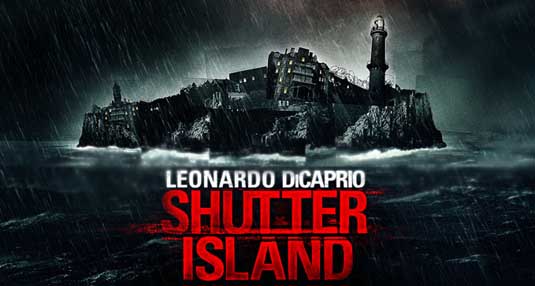
Shutter Island (Thriller) Martin Scorsese, 1995 Representation The opening scene after the opening title have rolled through is that of an island which appears in the middle of nowhere. At the time of filming the weather is dark and gloomy adding to the uncanny atmosphere. The audience is then introduced to the main character played by Leonardo Di Caprio. I think his name however is an oxymoron. He is called Teddy Daniels. A teddy is something a child would hug or hold and something that is soft and sparks happiness. This I think has been used to represent the distorted island as 'Shutter Island' is very harsh looking with large jagged rocks and accompanied by low key lighting doesn't match with the name 'Teddy'. The opening sequence is jam packed with little representations that underline what the film itself is all about, for example as you can see in the picture on the left hand side there is a foot stepping on a gun, this image possibly suggests that there is crime involved and deep mystery as only a foot is visible and not the persons face who possesses the gun, thriller films are full of this so the opening image makes sense. Mise en Scene Initially we are introduced to Leanardo Di Caprio he and his partner (Mark Ruffalo) are wearing dark grey overalls classic. The opening of the credits shows the audience a cage at the end of the corridor with a bed in it. This presents the setting as very dangerous as people are being imprisoned the question is why? The titles then cut to a spiralling staircase which creates a sense of mental entrapment and the descent into fear/ paranoia/madness as there seems to be no end to the staircase. The audience is then shown a room with water dripping from the ceiling this is found commonly in thrillers because it mirrors the way the story will be told, drip by drip, and how the audience will have to piece these small parts of information together. At the end of the opening credits there is a shot of the island from the title. It is surrounded by water and so is isolated which mirrors how the characters in this story feel and how their madness has caused them to be detached from the rest of the world. Low key lighting is used through out the opening credits which creates a sense of mystery which is typical of the thriller genre. Sound Before we have seen any acting displayed, we hear a very subtle but intriguing piece of classical orchestral music being played whilst the main credits are being displayed on screen. This is non-diegetic sound. This, from the very beginning of the opening sequence captures the audience's attention by the mellow, slow tempo and high pitched tone to it, it sets the atmosphere for what we are about to see. We then hear the gradual and subtle introduction of Foley sound, when the sea water and boat horns are introduced - before the first shot of DiCaprio (Teddy). The boat then appears through the mist. The use of the boat horn is one that is unexpected and acts as a warning/alarm for future scenes. The soundtrack throughout the entire opening title sequence is mysterious and is not loud but gradually builds up, this suggests to the audience that just like the genre and film it will surprise you when your not expecting it. Thrillers are well known for starting slowly but gradually gaining pace until they have the audiences full attention and begin, to twist their minds, shock them and grasp their attention in a flash. In a cinema environment the instruments chosen to play the song would at times seem boring but when their tone quickly increases with the pitch it may scare the audience preparing them for whats about to happen. Camera Our first glimpse of character is a distressed looking DiCaprio (Teddy) who appears to have sea sickness. We know this because of 2 major points: 1) his words - he says "pull yourself together...it's only water" and 2) his facial expression. In this close up you can see the emotion in his eyes and the look on his face tells you that he is distressed. Close ups are used to reveal details in the scene and is used here to not only reveal 'Teddy's' emotion but also the fact that he has water on his face. The fact his shirt is undone and the top suggest a stressed/laid back man who at this present moment at time is trying to get through this boat ride, foreshadowing how uncomfortable his time at 'Shutter Island will be' subsequently sparking questions such as why is he is going and what is going to happen at the island. In terms of camera shots and angles, the opening scene is very much full of establishing shots, as this is an opening title sequence the producers will aim to get the audience captivated and used to the setting of the film, hence why long shots and establishing shots are used to make sure the audience understand exactly where the film is set. This doesn't sound as if its a convention of a Thriller, however what the audience are yet to know is that they are being shown around a hospitalised prison for the criminally insane, a dark and chilling twist on a normal establishing shot, there are however some more chilling camera angles, for example the shot of the fire burning, which creates a sense of suspense and death.
Opening Titles Through out the opening titles the audience is shown parts of a man but never the full body which creates a sense of mystery and secrecy. it also creates a sense of unknown evil or threat leaving the audience guessing the identity of the antagonist. The viewer is left with the question who or what is lurking in the shadows. The use of the 360 degree pan is used to disorientate the viewer. Colour is kept minimal in order to build suspense due to surroundings being obstructed due to how dark it is. Only colour on screen is red text showing actors names. Red represents colour of blood suggesting thriller genre.
Narration and Form The opening sequence to 'Shutter Island' is surprisingly unrestricted, opposite to the norm in a conventional thriller opening. Whilst we are introduced to the setting, who the main characters are and what sort of story will unfold, one that is a crime drama due to prevalence of police and images of dungeons prisons. However it is hard to understand what the point of the island is and therefore in the respect of the island and not the characters it is relatively unrestricted. In addition it follows 2 or 3 lines of action. In the opening titles we see only the hands of a probable antagonist and this raises questions of their presence. The focus is then drawn to Teddy and his sea sickness and finally through the use of an establishing shot the audience's attention is then switched to the island. Target Audience and Sub Genre From the opening sequence alone the storyline only really follows that of a classic thriller. Low key lighting and build up in suspense being the common conventions. There are hints of a crime drama with the prevalence of police officers and links to dungeons and prisoners as well. After watching the whole film it is hard for one to get ones head around the plot. Their are many twists and possibly only a matured mind can not only cope with some of the violence and blood but also understand the deeper meaning.
Good Fellas (Drama) Martin Scorsese, 1990 Mise en scene and Representation Goodfellas takes place in Queens in New York City. It beings during the 1950s and ends in the 1980s. Historically, New York City is a known place for the Italian mob. By having the setting in this area, the viewer would believe that mob related activities take place there. Two other aspects are costumes and the behaviour of the characters. In many gangster films, the Italian mobster is usually well dressed. They typically wear nice clothes such as a shirt and tie. Scorsese went along with this notion in Goodfellas. All of the characters where fancy clothes and look like they are Italian so they could be depicted as Italian mobsters. They have an Italian accent and many of their conversations are about illegal activities that they would partake in. They give off a hard and fierce attitude to those who do not know them. Lighting is also an aspect of mise-en-scene. In the beginning scene of the movie, the three main characters are shown murdering a high-ranking Italian mobster. There is a red light in the scene, which has an underlying significance. The red light appears to almost look like a flashlight. The lighting resembles a blood like colour and it does not allow the viewer to see the blood that is covering the characters. The red light gives off a notion of death. In addition the lighting and setting, aside from the smart suits and haircuts, supports the secretive nature of the events that are taking place. The lighting is minimal, with only the car headlights to light the murder scene, and presumably streetlamps that light up the inside of the car at points. The lighting is deliberately dark because as I have said, the characters are trying to hide their criminal activities and do not want to be seen. However, use of a torch by the men or any other lighting device would have an inappropriate and unrealistic prop given the circumstances. The weapon props however are realistic and are used to define the brutality and the ruthlessness of criminals of that level. The carving knife, the shovel and the gun all appear in this scene to show that whatever is in making noise in the boot will die very painfully,
Camera
In the opening shots a tracking shot is used to pan left around the side of the car driving. By using this shot it makes the viewer feel as if they are driving alongside next to the car and give the feel that they are on the road with them. A tracking shot is used as the camera speeds up and passes the car again connoting that the audience will be watching a realistic portrayal of the gangster genre. A tracking shot is a type of shot often used by Scorsese and in this instance is used to establish the scene; we know that the focus is on a car and our attention should probably be on those in the car; it also gives the sense of movement and therefore excitement.When the film then cuts into the car a medium close up shot is used to show the three characters within the car. This shot enables the viewer to clearly see all three of the characters and what they are wearing and what the inside of the car is like. It is important to be able to show both of these things as they can both be significant to creating this image of the characters. As the viewer can see what the characters are wearing, all three of them wearing suits, they can start to build this picture of what these characters are like and can already recognise these men are most probably gangsters.
Sound
In the opening scene of "Goodfellas", diegetic and non-diegetic sound is used. In the opening credits, we hear a non-diegetic sound that sounds like a car engine undergoing the Doppler effect as it drives past (the frequency of the sound changes) and this corresponds to the text moving on the screen. Although no image has appeared on the screen yet, the noise of the car makes the audience think that cars will be involved. As the actors names scroll past a strange, low frequency non-diegetic sound begins to build in timbre, around 0:19, then fade away until the text reads, "This film was based on a true story." Here, the sound fades for a brief moment, to enhance the effect of the text on the audience, then the car engine noise resumes as a car appears in the frame. We hear nothing but the noise of the car for several seconds, building tension, especially when the frame changes to show the men in the car, the silence over the noise of the engine creates a very tense atmosphere.
As the men start talking and conferring with one another, a muffled thumping sound can be heard over the speech - although the speech indicates that this sound is in the scene, we don't know where it is coming from ("Did I hit something?", "Is it a flat?.. No.."). We then very clearly hear the sound of the car doors closing as the men walk out, and the faint noise of crickets and other bugs are very typical of a scene at night, and help emphasise how quiet it is elsewhere. The muffled noise continued, but this time it is diegetic as the camera focuses on the car boot when we can hear it [1:18]. No words are spoken, and the lack of noise further builds the tension in this scene - the noise is eventually broken by the man brandishing a large knife and the sound of the keys to unlock the boot moving against each other. Every small noise is emphasised due to the complete silence to create tension and build suspense to what will happen when the boot is opened. When it is eventually opened, we see a very bloody man mumbling hard to distinguish phrases, it sounds like he says "no.." repeatedly. Then we hear the noise of the man as he thrusts the knife into the man in the boot, and then the silence is pierced by the sound of several gunshots, that we can clearly associate with the action in the scene. We then hear the sound of another car driving past, but we do not see it, and the characters do not seem to react to this so we assume that it is not important, but that there was a risk of the characters being seen.
Finally we hear the a monologue; the character does not talk in the scene but the camera focuses on him so we assume it is his voice, and as he reaches the end of his sentence ("..gangster"), as "Rags To Riches" by Richard Adler and Jerry Ross fades in for the title sequence. This Jazz-like song helps to set portray the culture of era in which the film was set, which was already mentioned to be 1970.
Titles and Form
The first shot of the film is of a black background with the credits. Minimal wording appears on the screen, and the words quickly slide across the screen from the right in a large white font. The word that has just slid across the screen then reappears in a smaller white font, and stays still until it is replaced by the next larger word sliding across. The sound, that goes with the word transitions is presumably diegetic traffic noise, and gives the viewer an idea of the setting. The final sentence that the audience see on this background is “This film is based on a true story” this is used to get the viewer instantly believing of the story and the characters portrayed within it. The opening sequence introduces the audience straight into the gangster life adding to the realism of the harsh and violent way of living. The opening sequence only follows one line of action. That of the the gangsters in the car with someone in the boot. They then go on to kill the victim in the boot so in that respect it is restricted as we don't know who these characters are or the man in the boot. All in all though the opening sequence is one that is unrestricted. The genre has been established, we know who has killed someone and that they dub themselves as gangsters.
Within the first two minutes of this film one man had been brutally murdered visibly. We see him being stabbed on multiple occasions and then shot three times in the heart and whilst the plot doesn't seem that hard to follow this film would still be too violent for a younger audience and therefore justifying its 18 age rating. It could easily be mistaken for a crime, thriller or action due to the intensity and pace of the crime scene but would suit more for a drama due to unrestricted events and the sense of realism.
Sub Genres and Age Rating
Conventions
often a protagonist and antagonist
symbolism and representation is key for every object in the scene